

When dealing with small electronics (phones, smartwatches), laptops, or power banks, you will sometimes need to convert mAh to mWh (milli Amp-hours to milli Watt-hours). To help you with the conversion, we prepared these 2 key tools:
- mAh to mWh calculator. Here, you insert mAh and the voltage (usually 3.7V or 5V for phones, smartwatches, power banks, and 12V for standard batteries), and you get mWh right away.
- mAh to mWh conversion chart. We made the most common mAh to mWh conversion (ranging from 1 mAh to 1,000,000 mAh) at 3.7V, 5V, and 12V voltage. All the results are gathered in a neat conversion chart (below the calculator).
Easy example: In the photo above, we see a small 10,000 mAh power bank (it runs on 3.7V). How much “juice” does this 10,000 mAh power have in mWh? We simply need to multiply 10,000 mAh by 3.7V; the power bank thus has 37,000 mWh capacity (equal to 37Wh, as written on the bank’s specs).
iPhone 16, for example, has a 3,561 mAh capacity lithium-ion battery operating at 3.7V. That means it has 13,175.7 mWh (or 13.2 Wh) capacity. A small 10,000 mAh power bank can fully charge (from 0% to 100%) two iPhone 16 smartphones.
This was an easy example. The following calculator does this conversion automatically, and the conversion chart includes this example. Here is the calculator you can freely use:
Here is how this calculator works:
Let’s say we want to convert 20,000 mAh to mWh. If this is a power bank running on a 3.7V lithium battery, we just insert ‘20000’ in the 1st mAh input field and ‘3.7’ in the 2nd voltage input field. Here is the result (screenshot):
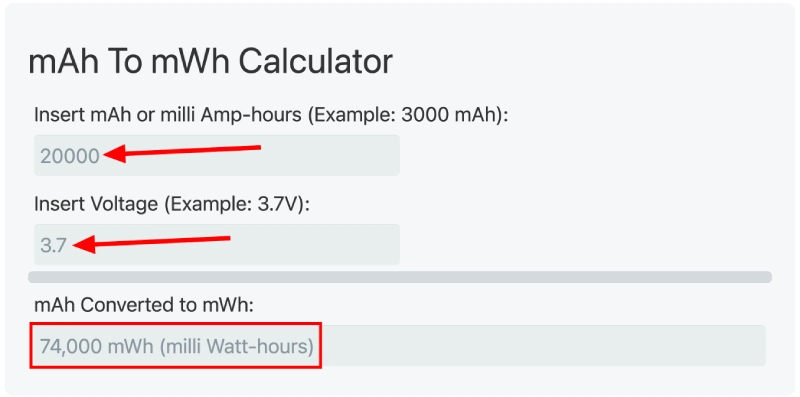
We see that a 20,000 mAh 3.7V power bank has a 74,000 mWh (or 74 Wh) capacity. You can find a similar calculator in reverse – converting mWh to mAh – here.
You can use the calculator above to make any mAh to mWh conversion. We did the most common conversion at 3.7V, 5V, and 12V voltages, and gathered all the results in this conversion chart:
mAh To mWh Conversion Chart
| mAh: | mWh (At 3.7 Volts): | mWh (At 5 Volts): | mWh (At 12 Volts): |
| 1 mAh | 3.70 mWh | 5 mWh | 12 mWh |
| 10 mAh | 37 mWh | 50 mWh | 120 mWh |
| 50 mAh | 185 mWh | 250 mWh | 600 mWh |
| 100 mAh | 370 mWh | 500 mWh | 1,200 mWh |
| 500 mAh | 1,850 mWh | 2,500 mWh | 6,000 mWh |
| 1,000 mAh | 3,700 mWh | 5,000 mWh | 12,000 mWh |
| 1,500 mAh | 5,550 mWh | 7,500 mWh | 18,000 mWh |
| 2,000 mAh | 7,400 mWh | 10,000 mWh | 24,000 mWh |
| 2,500 mAh | 9,250 mWh | 12,500 mWh | 30,000 mWh |
| 3,000 mAh | 11,100 mWh | 15,000 mWh | 36,000 mWh |
| 3,500 mAh | 12,950 mWh | 17,500 mWh | 42,000 mWh |
| 4,000 mAh | 14,800 mWh | 20,000 mWh | 48,000 mWh |
| 4,500 mAh | 16,650 mWh | 22,500 mWh | 54,000 mWh |
| 5,000 mAh | 18,500 mWh | 25,000 mWh | 60,000 mWh |
| 5,500 mAh | 20,350 mWh | 27,500 mWh | 66,000 mWh |
| 6,000 mAh | 22,200 mWh | 30,000 mWh | 72,000 mWh |
| 6,500 mAh | 24,050 mWh | 32,500 mWh | 78,000 mWh |
| 7,000 mAh | 25,900 mWh | 35,000 mWh | 84,000 mWh |
| 7,500 mAh | 27,750 mWh | 37,500 mWh | 90,000 mWh |
| 8,000 mAh | 29,600 mWh | 40,000 mWh | 96,000 mWh |
| 8,500 mAh | 31,450 mWh | 42,500 mWh | 102,000 mWh |
| 9,000 mAh | 33,300 mWh | 45,000 mWh | 108,000 mWh |
| 9,500 mAh | 35,150 mWh | 47,500 mWh | 114,000 mWh |
| 10,000 mAh | 37,000 mWh | 50,000 mWh | 120,0000 mWh |
| 11,000 mAh | 40,700 mWh | 55,000 mWh | 126,000 mWh |
| 12,000 mAh | 44,400 mWh | 60,000 mWh | 132,000 mWh |
| 20,000 mAh | 74,000 mWh | 100,000 mWh | 240,000 mWh |
| 50,000 mAh | 185,000 mWh | 250,000 mWh | 600,000 mWh |
| 100,000 mAh | 370,000 mWh | 500,000 mWh | 1,200,000 mWh |
| 1,000,000 mAh | 3,700,000 mWh | 5,000,000 mWh | 12,000,000 mWh |
With this chart, you can now just check how many mAh you have and what is the voltage (usually 3.7V for lithium-ion batteries, 5V, or 12V) and just read the mWh equivalent from this chart.
We hope these 2 tools help you convert any milli Amp-hours to milli Watt-hours. If you need a bit of help, you can always use the comment section below, tell us what you want to solve, and we can lend you a hand.